
TODO: add cool quote here.
Singer/ Songwriter
Overview
Tactical investing describes an investment style where the assets held in a portfolio change over time, without making any assumptions about how the holdings are determined at any given time. For the purpose of this book, we focus on strategies that determine the asset holdings based on quantitative analysis. These strategies rely purely on mathematical models, avoiding human bias and preference.
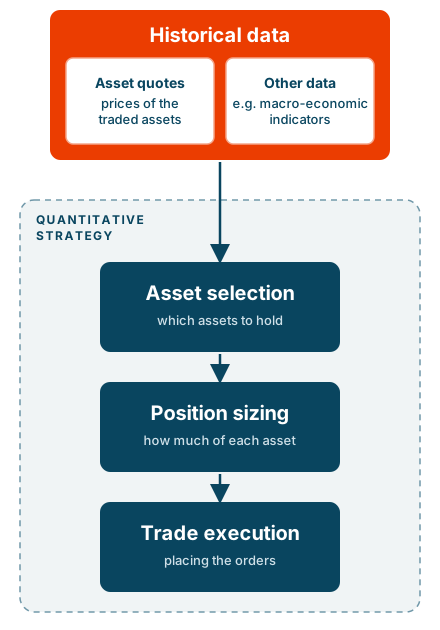
The image above shows the structure of a typical quantitative investment strategy. As input, we have historical data. Most importantly, these are historical quotes of the traded asset, but they can also include any other historical data, e.g., macro-economic indicators. Based on these data, the strategy selects the assets to hold. Once these are determined, the strategy calculates the position size for each portfolio asset. Finally, a component performs the trade execution.
The fact that these strategies base their decisions on historical data also explains their main shortcoming. Because a new situation has to emerge before the strategy can react to it, there is always some delay. This reduces the strategy’s efficacy and defines the range of economic scenarios it covers successfully.
Trend-Following Strategies
The simplest tactical investment strategies are trend-following strategies. The idea behind this type of strategy is simple: a trend, once established, is expected to continue for a while. A famous investor quote goes: “The trend is your friend, until the end when it bends.” And this makes some intuitive sense. A company that was successful yesterday is likely to do well today, or even tomorrow.
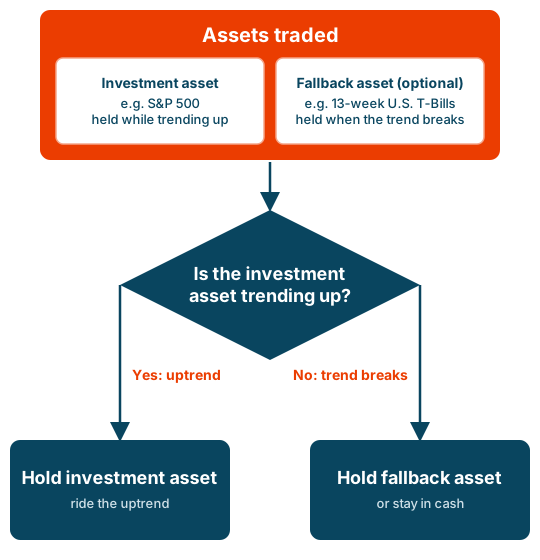
Trend-following strategies typically trade one or two assets. The first one is the investment asset, e.g., the S&P 500. The second, optional one is the fallback asset, e.g., 13-week U.S. Treasury Bills. If the investment asset is trending up, we invest in it. If the trend breaks, we either hold cash or the fallback asset.
Trend-following strategies work surprisingly well, as they are able to cut losses when entering prolonged recessions. However, we should not expect these strategies to outperform the investment asset. During bullish periods, these strategies will be on par with the investment asset. When entering a recession, trend-following strategies will take some losses before exiting the market. And when the market recovers, it will take a while before the strategy goes back in. This friction will inevitably cost performance, especially in choppy markets. But the reduced downside and better predictability of outcomes are likely worth that friction.
Momentum Strategies
Momentum strategies expand on the idea of trend-following. But instead of predicting whether asset prices are rising or falling, these strategies predict momentum, which is the velocity at which prices are changing. And again, it makes some intuitive sense that future asset momentum can be predicted by looking at the past.
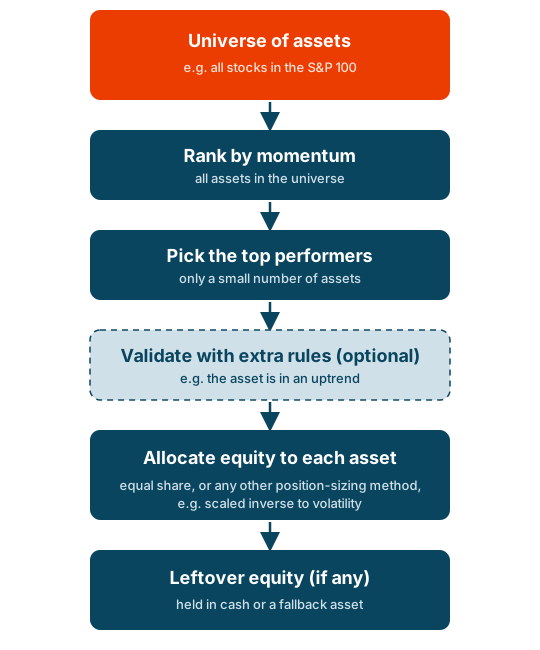
Momentum strategies typically trade a defined universe of assets, e.g., all stocks in the S&P 100, and at any given time invest in a small number of them. To pick the assets to hold, the strategy ranks all assets in the universe by their momentum and picks the top performers. Optionally, the assets may also be qualified by additional rules, e.g., a rising trend. Each of the selected assets is then allocated some capital. This may be an equal share for all assets held, or determined by any other position-sizing method. For example, position sizes may be scaled inversely to asset volatility. If any capital is left unallocated at the end of this process, it may be held in cash or invested in a fallback asset.
Again, momentum strategies often work surprisingly well. However, momentum is a very noisy measure. Especially when the traded assets are similar to each other, in directionless markets, or in times of increased market volatility, momentum strategies may have a hard time identifying a stable set of top performers. Instead, these strategies then tend to churn through the universe, creating additional friction and falling behind buy-and-hold.
Mean-Reversion Strategies
Mean-reversion strategies take the idea of momentum another step further. Momentum strategies assume that asset momentum remains stable in the mid-term. Mean-reversion strategies assume the very same thing, and trade the implication that despite some short-term disturbances, assets should revert to their longer-term momentum.
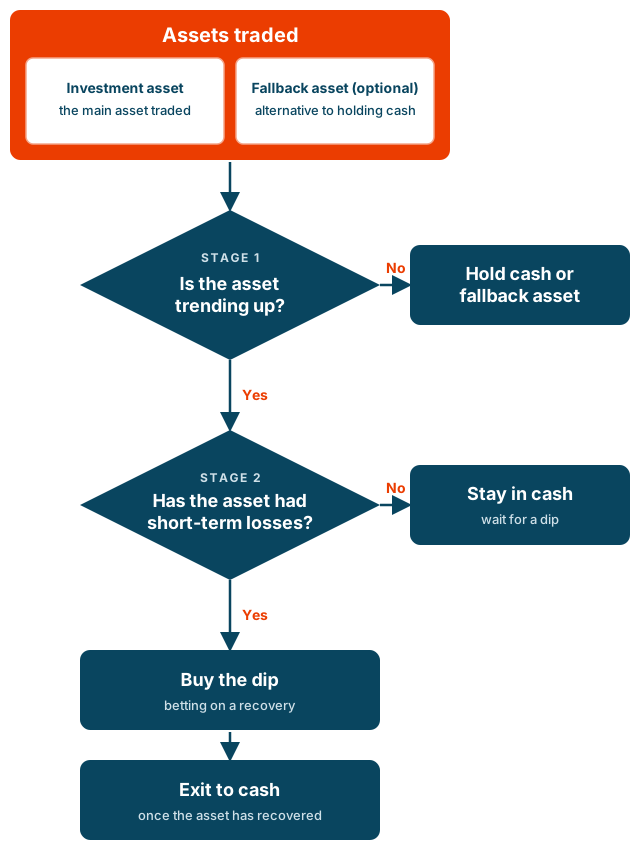
Like trend-following strategies, most mean-reversion strategies trade only an investment asset, plus an optional fallback asset. In the first stage, the strategy confirms that the investment asset is in an uptrend. If it is not, the strategy either goes to cash or invests in the fallback asset. But if the investment asset is trending up, a second stage follows. Here, the strategy determines if the investment asset has suffered short-term losses. If it has, the strategy buys into the dip, betting on the asset to recover swiftly. Once the asset has indeed recovered, the strategy exits to cash.
As counterintuitive as their mechanics might be, these simple strategies also work very well. As Larry Connors put it: “Buy the fear and sell the greed.” Unlike trend-following and momentum strategies, mean-reversion strategies are only in the market for a few days at a time, during which they reap outsized returns. However, their use of the assigned capital is often relatively poor, unless a fallback asset is employed. Their risk profile typically looks very tame, as they won’t invest in downward-trending markets. However, it is worth pointing out that when entering a position, these strategies cannot distinguish between a short-term dip and the onset of a market collapse. Consequently, they carry substantial tail risk, equal to investing 100% of the capital in the investment asset.
| Strategy Type | Underlying Assumption |
|---|---|
| Buy-and-hold investing | • Long-term directions of asset prices remain stable • Correlations between assets remains stable |
| Trend-following | • In the mid-term, trends remains stable |
| Momentum investing | • In the mid-term, momentum remains stable |
| Mean-reversion | • In the mid-term, momentum remains stable • In the short-term, momentum reverts back to its mean |
Conclusion
The table above compares the underlying assumptions of the various investment approaches. As hinted at in the Strategic Investing chapter, all approaches are guilty of data mining. In each case, we make observations based on historical data, and we expect these observations to carry over into the future. The specific assumptions being made seem rather similar. In other words, it is hard to make the case that tactical investing strategies per se are more prone to failure than strategic investing is.
In more than 15 years of trading quantitative strategies, I have experienced firsthand that certain market conditions favor strategic investing, while at other times tactical strategies excel. My conclusion from this observation is to combine multiple strategies with different assumptions and methods into strategy blends, in an attempt to make the portfolio more robust and better able to deal with a wider range of situations. This is exactly what this book presents in the section on Tactical Strategies.